The Ultimate Guide to T-Shirt Fabrics, Yarn & GSM: What Brands Need to Know Before Production
At first glance, making a t-shirt seems simple. You choose a fabric, decide on a fit, add your design, and you are ready to go.
But the moment you start speaking with a manufacturer, things change quickly. Suddenly, you are surrounded by terms like GSM, ring-spun, jersey, blends, finishing. And the real question becomes: are you actually speaking the same language?
Because two fabrics can have the same composition, even the same weight, and still feel completely different. One feels soft and premium, the other stiff and basic. The difference lies in details most brands underestimate at the beginning, yarn type, fabric construction, and processing.
If you want to build a product that truly represents your brand, you need to understand what you are investing in. This guide will give you exactly that clarity. Not just definitions, but a way to think about fabrics like someone inside the industry.
What Actually Defines a Fabric
A fabric is never just “cotton” or “polyester”. It is always the result of multiple factors working together:
• the fiber, cotton, polyester, linen, hemp or rayon
• the yarn type and spinning method
• the fabric construction, such as single jersey or interlock
• the fabric weight, measured in GSM
• and the finishing processes applied after knitting
This combination is what creates the final handfeel, durability and performance of a garment.
Understanding Fibers: Natural, Synthetic and Semi-Synthetic
Cotton is still the most widely used fiber in t-shirts. It is breathable, soft and familiar to customers. But even within cotton, there are different quality levels, and those differences matter more than most people expect.
Carded vs Combed Cotton: What’s the Difference?
Carded cotton is the more basic version. The fibers are cleaned and roughly aligned, but shorter fibers and inconsistencies remain. This results in a slightly rougher handfeel and less durability over time.
Combed cotton goes through an additional refining process where short fibers and impurities are removed. What remains are longer, more uniform fibers, creating a smoother, stronger and more refined fabric with a cleaner surface.
Pima vs Supima Cotton
At the premium end, you will find Pima cotton, an extra-long staple cotton known for its softness, strength and color retention.
Supima is a certified version of Pima cotton grown in the United States. It follows stricter quality standards and offers more consistency and traceability. Both are considered premium, but Supima is typically positioned at the very top of the market.
Mercerized Cotton: When Cotton Becomes More Refined
Mercerized cotton undergoes a controlled chemical treatment that causes the fibers to swell and align more uniformly. The result is a smoother, slightly lustrous fabric with improved strength.
One of its biggest advantages is how it absorbs dye. Colors appear deeper, more vibrant and more long-lasting. This makes mercerized cotton a strong choice for collections where a cleaner, more elevated look is important.
Beyond cotton, other fibers start to shape how a product feels and performs.
Linen, made from flax fibers, is lightweight, breathable and ideal for warm climates, but wrinkles easily and requires a more relaxed aesthetic.
Hemp is one of the most durable natural fibers available. It is naturally antibacterial, moisture-wicking and temperature regulating. Traditional mechanical hemp can feel rough and is often blended with cotton, while newer viscose hemp creates a softer, smoother fabric that feels closer to bamboo or silk.
Rayon, also known as viscose, sits between natural and synthetic fibers. It is made from plant-based cellulose that is chemically processed into fibers. Variations like bamboo rayon, modal or lyocell are known for their soft, fluid and slightly silky feel.
Polyester represents the synthetic side. It is durable, lightweight and performs particularly well in activewear. It also plays a key role in certain printing techniques, but lacks the natural breathability of cotton.
Blends combine different fibers to balance performance, comfort and cost. Cotton-poly blends improve durability and shape retention, while tri-blends add softness and drape, often used for a more fashion-forward look.
Yarn: The Hidden Driver of Quality
Before a fabric becomes fabric, it is yarn. And how that yarn is made has a significant impact on the final result, often more than the fiber itself.
Ring-Spun vs Open-End Yarn
Ring-spun yarn is produced by continuously twisting and refining fibers. This creates a finer, smoother and stronger yarn, which is why it is typically used in higher-quality garments.
Open-end yarn is produced faster and at lower cost. It creates a bulkier yarn with a slightly rougher texture, making it suitable for more price-driven products or garments where a heavier, more textured feel is desired.
Air-spun yarn uses air pressure to twist the fibers, resulting in a softer, more voluminous yarn with a slightly fuzzy surface. It is often used for garments designed to feel more relaxed and comfortable.
Slub yarn is intentionally uneven, with thicker and thinner sections throughout the yarn. This creates visible texture in the fabric and is often used for a more casual or vintage look.
Elastic fibers such as elastane can be introduced to add stretch and recovery. This improves comfort and fit, especially in slimmer silhouettes, but needs to be balanced carefully as it can influence durability over time.
Yarn Count & Ply: What They Actually Tell You
Yarn count, often written as 30s or 30/1, describes the fineness of the yarn. Higher numbers indicate finer yarns, resulting in softer, lighter and more refined fabrics. Lower numbers indicate thicker yarns and a more robust, heavier feel.
Ply refers to how many yarn strands are twisted together. Single yarn fabrics are lighter and softer, while multi-ply yarns increase strength and structure, but also change the overall handfeel.
High-Count Yarn: Why Finer Feels Better
High-count yarn fabrics are made using very fine yarns that are tightly constructed. The result is a fabric that feels smoother, lighter and more refined, often with a cleaner and slightly more polished surface.
These fabrics are typically used in more premium t-shirts where softness, drape and a more elevated look are important.
Fabric Construction: Why Structure Changes Everything
Even with the same fiber and yarn, construction can completely change how a fabric behaves.
Single Jersey vs Interlock (Double Jersey): How Fabric Construction Changes Everything
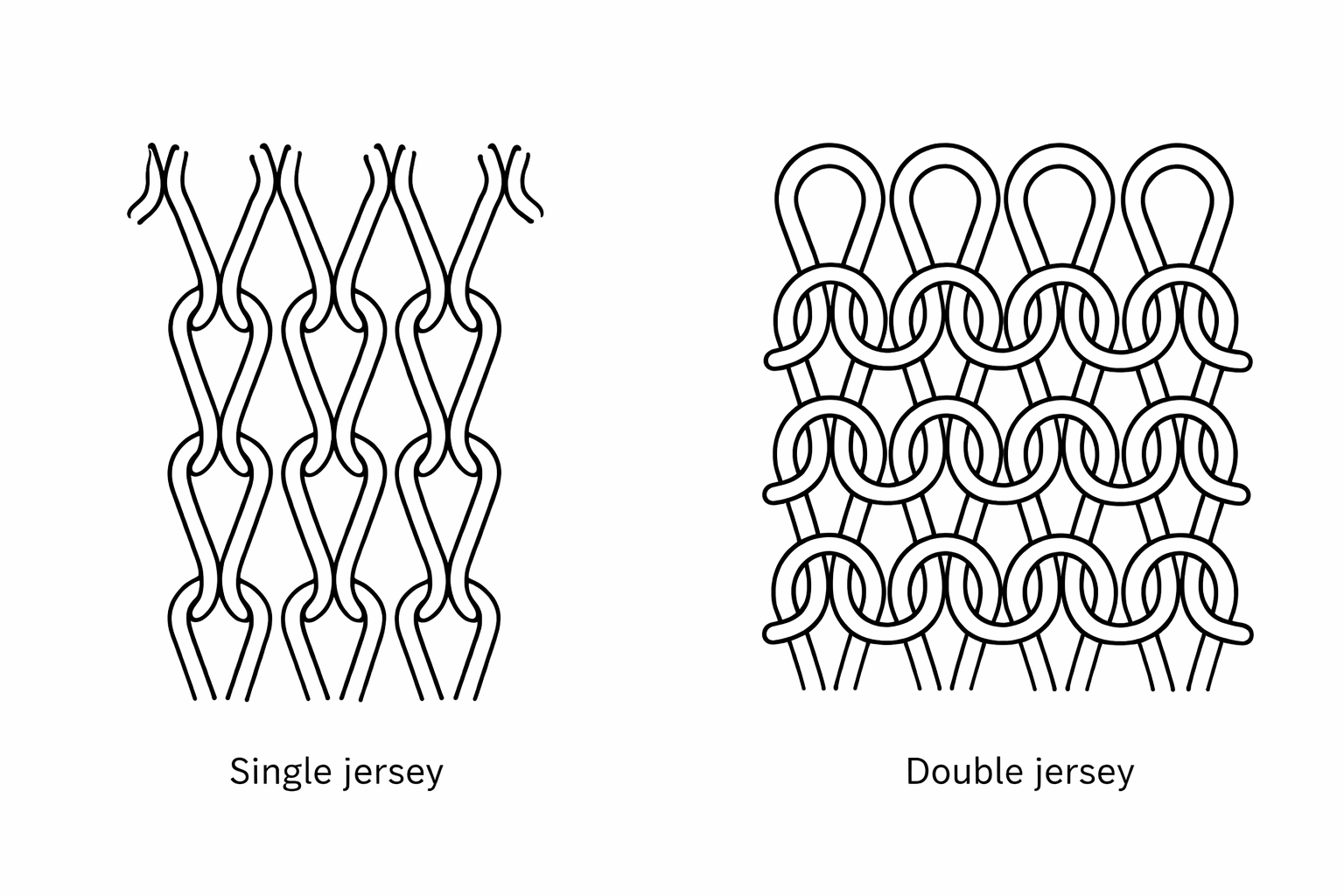
Single jersey is the most common construction for t-shirts. It is lightweight, flexible and has a smooth front with a softer back.
One important detail is that single jersey tends to curl at the edges, especially when cut. It can also be slightly more transparent depending on the weight, and the front and back are visibly different. This makes it easy to recognize once you know what to look for.
Interlock, also known as double jersey, is created by knitting two layers together. This results in a thicker, more stable fabric that feels smoother and more structured.
Unlike single jersey, it does not curl at the edges, looks the same on both sides and is typically less see-through. Because of this, it is often perceived as more premium and is used in higher-end or more structured products.
Double Constructions, French Terry & Fleece
Double constructions combine multiple yarn systems or layers, resulting in thicker and more durable fabrics.
French terry, commonly used for sweatshirts, features looped yarns on the inside and a smooth outer surface. In heavier weights, it can also be used for structured t-shirts or transitional pieces.
Fleece builds on this by brushing the inside, creating a soft, insulating layer. It is primarily used for colder-weather garments where warmth and comfort are key.
GSM: Understanding Fabric Weight Properly
GSM, grams per square meter, measures how heavy and dense a fabric is. But more importantly, it defines how the fabric behaves in real use.
Instead of looking at GSM as a fixed number, it helps to understand it in ranges:
• 130 to 160 GSM is lightweight, soft and breathable, often used for summer or activewear
• 160 to 180 GSM offers a balanced feel, suitable for everyday basics
• 180 to 200 GSM provides more structure and durability, common in retail collections
• 200 GSM and above moves into heavyweight territory, often used for premium or streetwear pieces
However, GSM alone does not define quality. A well-made 160 GSM ring-spun fabric can feel significantly more premium than a poorly constructed 220 GSM fabric.
Shrinkage, Washing and Finishing
Shrinkage is one of the most common challenges in garment production, particularly with natural fibers like cotton. To reduce this risk, manufacturers often apply pre-washing or enzyme washing processes before cutting and sewing. These treatments stabilize the fabric, soften the handfeel and help control shrinkage after the first washes.
Brushed & Surface Finishes
Finishing processes can completely transform how a fabric feels. Brushed fabrics are created by mechanically raising the surface fibers, resulting in a soft, slightly fuzzy texture that adds warmth and comfort. Other treatments, such as enzyme washes, create a softer, more worn-in feel and give garments a more premium appearance from the very beginning.
Choosing the Right Fabric: A More Realistic Perspective
Not every product needs the most expensive fabric. What matters is alignment between product intention, price positioning and customer expectations.
A 160 GSM ring-spun jersey can outperform a poorly made heavyweight fabric. And a well-finished carded cotton can still be the right choice for a more price-driven product.
The strongest products are not defined by the most expensive materials, but by the right decisions.
When making those decisions, it helps to consider:
• the purpose of the product
• the environment it will be worn in
• the expected handfeel and fit
• durability requirements
• and your price positioning
A Quick Note on Printing
Different fabrics interact differently with printing techniques. Cotton works best for DTG and DTF printing, where the ink bonds directly with the fibers. Polyester is required for sublimation printing, which produces vibrant and long-lasting results. Blends can work depending on the method, but usually require testing. This is a topic we will explore in more detail in a separate guide.
Final Thoughts
Once you understand how fibers, yarn, construction and finishing come together, fabric selection stops being guesswork.
You start making decisions with intention. And that is exactly what separates average products from strong ones.
If you are just starting out, scaling your brand or dealing with production challenges, you do not have to figure this out alone.
If you are currently looking for the right production partner, you might also find this helpful:
→ Read our guide on how to find the right clothing manufacturer in Turkey
At The Source Apparel, we help you make the right sourcing decisions, connect you with the right manufacturers and take the operational complexity off your plate. You can explore our services to learn more.
So you can focus on what really matters, building your brand.